Blog
Working Capital: 5 DCF Steps and an Auditable Example
Learn how working capital changes affect FCFF and FCFE, calculate and project noncash working capital, and test assumptions with an auditable DCF example.

In DCFs, an increase in non-cash working capital is a use of cash that reduces free cash flow, while a decrease is a source of cash that raises free cash flow. Non-cash working capital excludes cash and short-term debt, isolating the operating cash tied up in receivables, inventory and payables. This change appears as a direct subtraction in the canonical FCFF formula.
TL;DR:
- Analysts should exclude cash and interest bearing short term debt, then calculate noncash working capital as operating current assets less nondebt current liabilities.
- Analysts should project working capital as a percentage of revenue, using multiyear averages or industry norms instead of extrapolating an anomalous year.
- Companies with negative working capital may generate near term cash, but analysts should phase it toward zero or a sustainable revenue share as growth slows.
- Because terminal value often dominates DCFs, test working capital assumptions with sensitivities, including a comparison of 8% and 4% revenue ratios.
Table of Contents
- Where Change in Working Capital Sits in FCFF and FCFE
- Calculating Change in Non-Cash Working Capital Step by Step
- Projecting Working Capital and Normalizing It for Terminal Value
- Negative Working Capital, Volatility and the Discounting Rationale
- A Hypothetical Walkthrough: Working Capital and Free Cash Flow
- Modeling Checklist: Avoiding Common Working Capital Mistakes
- Why Transparent Working Capital Assumptions Matter in Published Models
- Testing Working Capital Assumptions in an Editable Model
- FAQ
- Sources
Where Change in Working Capital Sits in FCFF and FCFE
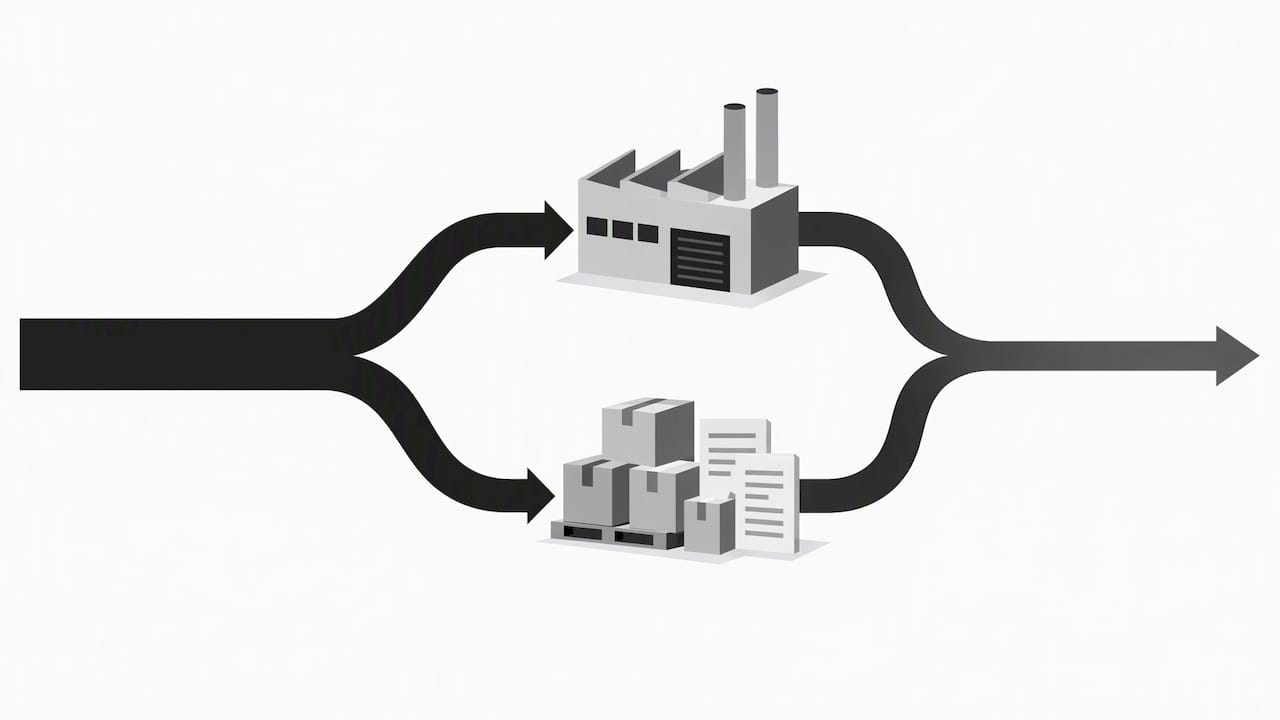
The standard FCFF formula treats working capital as a reinvestment line alongside capital expenditures: EBIT(1 - t) + Depreciation - CapEx - Change in Non-cash Working Capital, as laid out in Working capital in valuation. This placement is not arbitrary. Working capital investment behaves like a capital expenditure: both consume cash now to support revenue the business expects to collect later.
FCFE follows the same logic but starts from net income and, in some formulations, adjusts the working capital change by the firm’s debt ratio when reconciling between FCFF and FCFE, a conversion detailed in Discounted Cash Flow Valuation.
Valuation practitioners exclude cash and interest-bearing short-term debt from the working capital definition for a specific reason, explained on pages.stern.nyu.edu:
- Cash is a financing asset, not an operating one, and belongs in the discount rate and capital structure, not in operating cash flow.
- Short-term debt is a financing liability, and including it in working capital double counts financing effects already captured elsewhere in the model.
- Mixing these items creates circularity between the balance sheet and the discount rate.
Calculating Change in Non-Cash Working Capital Step by Step
Non-cash current assets include accounts receivable, inventory and prepaid expenses. Non-debt current liabilities include accounts payable and accrued liabilities, each defined in Discounted Cash Flow Valuation: The Inputs. Together, non-cash current assets minus non-debt current liabilities equal non-cash working capital (NWC), and the year-over-year change follows a simple structure.
- Calculate NWC for the current period: non-cash current assets minus non-debt current liabilities.
- Calculate NWC for the prior period using the same line items.
- Subtract: Change in NWC = NWC(t) - NWC(t-1).
- Trace each balance to the cash flow statement, where working capital reconciliation items typically appear within operating activities.
- When historical changes look erratic, smooth the series by projecting NWC as a percentage of revenue instead of extrapolating a single year.
Pro Tip: Strip cash and short-term debt out of every current asset and liability line before computing the change, or the financing side of the balance sheet will quietly distort your operating cash flow.
Projecting Working Capital and Normalizing It for Terminal Value
Year-to-year working capital changes swing with seasonality, inventory builds and one-off receivable timing, which makes a single historical year an unreliable driver. Discounted Cash Flow Valuation: The Inputs recommends projecting working capital as a percentage of revenue instead, since revenue tends to move more predictably than the underlying balance sheet accounts.
- Use a composite percent-of-revenue estimate for most forecasts; it is simpler and, for many companies, more accurate than itemizing every line.
- Break working capital into components (separate inventory days, receivable days, payable days) only when a business has a genuinely distinct cycle worth modeling, such as a manufacturer with long production runs.
- In the terminal period, phase working capital needs toward a stable percentage of revenue or an industry average rather than carrying forward an unusual base-year ratio.
- Treat persistently negative working capital with caution; it is rarely sustainable indefinitely and should be normalized unless there is a structural reason it will continue.
The trade-off is straightforward: more detail demands more assumptions, and each added assumption is another place for error to creep into the model.
Negative Working Capital, Volatility and the Discounting Rationale
Some business models, retailers and subscription companies among them, collect cash from customers before paying suppliers, producing negative non-cash working capital that temporarily releases cash into the business. Discounted Cash Flow Valuation: The Inputs treats this pattern as useful but temporary: as growth slows and the business matures, that release tends to shrink or reverse, so analysts are advised to cap or phase negative working capital toward zero or a sustainable percentage rather than assume it continues forever.
- Negative non-cash working capital can boost near-term free cash flow, but assuming it persists unchanged through the terminal period overstates value.
- Volatile historical changes, a one-time inventory drawdown or a receivable timing shift, should never be plugged directly into a multi-year forecast; a multi-year average or an industry percent-of-revenue is the more defensible input.
- Working capital investment is part of the firm’s operating reinvestment, which means it should be discounted at the overall cost of capital in an enterprise-value framework, not at a separate rate, a point made in the theoretical treatment of these cash flows.
A company efficient at managing receivables, inventory and payables ties up less cash per dollar of revenue, which, all else equal, raises free cash flow and therefore value. That single relationship is why working capital assumptions deserve as much scrutiny as revenue growth or margin assumptions in a DCF model.
A Hypothetical Walkthrough: Working Capital and Free Cash Flow
The following is a hypothetical, illustrative exercise, not a forecast of any real company.
- Scenario A (working capital at 8% of revenue): Year 1 EBIT is $20.00, after-tax EBIT is $15.00, depreciation is $4.00, capex is $5.00. Change in NWC from a $0 base is $8.00 (8% of $100). FCFF = 15.00 + 4.00 - 5.00 - 8.00 = $6.00.
- Year 2 (Scenario A): Revenue is $110.00, EBIT $22.00, after-tax EBIT $16.50, depreciation $4.40, capex $5.50. NWC rises from $8.00 to $8.80, a change of $0.80. FCFF = 16.50 + 4.40 - 5.50 - 0.80 = $14.60.
- Year 3 (Scenario A): Revenue is $121.00, EBIT $24.20, after-tax EBIT $18.15, depreciation $4.84, capex $6.05. NWC rises to $9.68, a change of $0.88. FCFF = 18.15 + 4.84 - 6.05 - 0.88 = $16.06.
Because terminal value is typically the largest component of a DCF, even a four-point swing in the working capital percentage can move the implied enterprise value by a meaningful margin, which is why the assumption deserves a sensitivity test rather than a single static guess. Readers can test the assumption in a spreadsheet by swapping the
input for 4% and tracing the effect line by line.
Modeling Checklist: Avoiding Common Working Capital Mistakes
A few recurring errors account for most of the distortion in working capital lines, and each has a straightforward fix.
- Keep cash and short-term debt out of the non-cash working capital calculation, and document every balance sheet line used to compute it.
- Avoid anchoring long-term projections to a single anomalous year; compute working capital as a percentage of revenue across several years and test how sensitive the valuation is to that percentage.
- Check that working capital assumptions move in step with revenue growth drivers, since a model that grows revenue aggressively while holding working capital flat is internally inconsistent.
- Reconcile projected ratios against historical company averages and industry norms before finalizing them.
Pro Tip: Add a notes cell next to every working capital input explaining which balance sheet lines it comes from and any cap or phasing decision applied, so the assumption stays auditable months later.
Why Transparent Working Capital Assumptions Matter in Published Models
Working capital assumptions are easy to bury inside a single growth input, which makes models hard to audit and easy to misjudge. We publish every assumption behind our valuation models, including the working capital inputs, with the filing or data feed each one draws from, so a reader can trace the number rather than take it on faith. That transparency is also what makes sensitivity checks useful: when an assumption is visible, swapping it and watching the output move becomes a genuine learning exercise rather than a guess. For a related audit-friendly adjustment, see our breakdown of net cash adjustments for model builders.
— Miraaj Patel
Testing Working Capital Assumptions in an Editable Model
Building the working capital line by hand in a spreadsheet is a useful exercise, but checking it against a live, documented model is faster once you understand the mechanics. Our pricing page outlines the Free plan and the Pro plans, Pro · annual at $99 per year and Pro · monthly at $14.99 per month, which include the editable model, the downloadable workbook and the full screener for readers who want to adjust working capital percentages, growth and WACC dials themselves.

This is a learning and analysis tool, not investment advice: no figure here is a price target or a recommendation to buy, sell or hold anything. Start by browsing a published model on the TickerWorth homepage to see how working capital and other DCF inputs are laid out before deciding whether the editable version is worth exploring further.
FAQ
How do you calculate working capital?
Non-cash working capital equals non-cash current assets, such as accounts receivable and inventory, minus non-debt current liabilities, such as accounts payable, as defined in Discounted Cash Flow Valuation: The Inputs. The change from one period to the next is what feeds into the free cash flow calculation.
What is working capital and its example?
Working capital, in the non-cash sense used in DCF modeling, is the cash a business has tied up in operating accounts like receivables and inventory after netting out payables.
What qualifies as working capital?
In valuation, non-cash working capital includes operating current assets such as accounts receivable, inventory and prepaid expenses, and non-debt current liabilities such as accounts payable and accrued expenses, per Discounted Cash Flow Valuation: The Inputs. Cash, marketable securities and short-term debt are deliberately excluded because they belong to financing, not operations.
What is a good working capital ratio?
There is no single universal ratio, since the appropriate level of working capital varies widely by industry and business model. The more useful benchmark in DCF work is a company’s own historical non-cash working capital as a percentage of revenue, compared against industry peers, rather than a fixed target number.
Why does an increase in working capital reduce free cash flow?
An increase in non-cash working capital means more cash is tied up in receivables or inventory than is being freed up through payables, which is cash the business cannot use elsewhere. That cash outflow is subtracted directly in the FCFF formula, the same way capital expenditures are.
Recommended
- Terminal Value Methods: A Checklist for Practitioners
- Asset Based Valuation for Investors: 4 Steps and an Auditable Example
- Audit Ready Net Cash Adjustments for Model Builders
This article was written with AI assistance and edited for TickerWorth. It is educational only and is not investment advice, a recommendation or a price target. Figures are as of the publish date; for the live, sourced valuation of any company, see tickerworth.com.
Fair value
Check any ticker’s fair value
Type a ticker for today’s estimate of what the business is worth, with every assumption and where it came from. When the data can’t support a number, the page says why.